

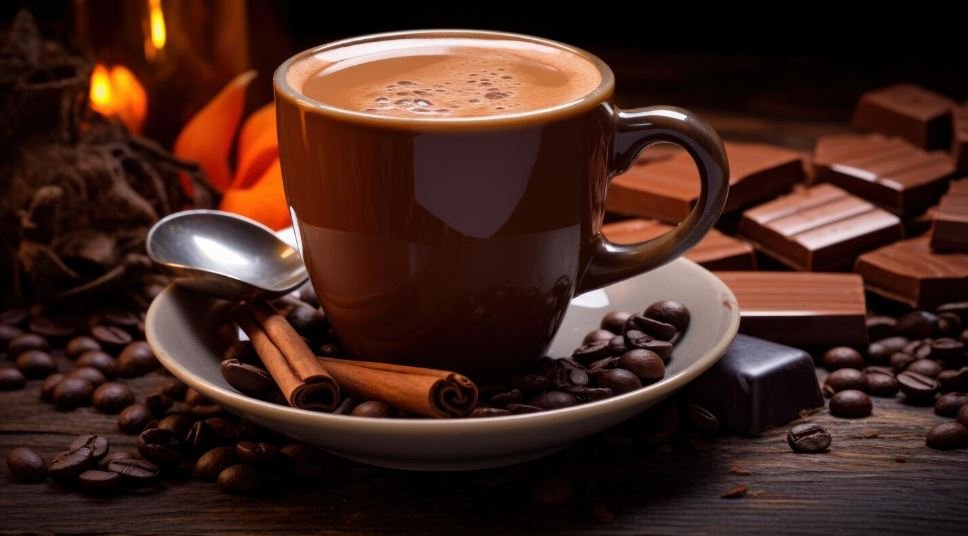
A mug of hot chocolate on a chilly nite has an almost therapeutic quality. Warm, sweet, and a little rich, it falls somewhere between comfort and dessert. People have been using it as a coffee substitute for years, believing it has no negative connotations. There’s no reason to feel bad about having another cup, no jitters, and no late-night awakenings. As it happens, that assumption is largely correct, but not totally.
Caffeine is present in hot chocolate. It’s not much, but it exists. A typical eight-ounce cup of a powdered mixture, such as Swiss Miss, contains about five milligrams of caffeine, sometimes even less. The brand claims that its traditional blend is 99.9 percent caffeine-free, which is as close to zero as it gets without actually being zero. Nevertheless, it’s important to know, particularly if you monitor every milligram.
As you climb the quality ladder, things become more intriguing. Due to the cocoa in their mocha sauce, a sixteen-ounce Starbucks hot chocolate has about twenty-five milligrams of caffeine. That’s still only about 25% of the 95 milligrams that make up a typical cup of drip coffee. Therefore, even though it’s not insignificant, this number shouldn’t cause anyone to worry about their evening routine.
Cocoa solids, the portion of the cacao bean that contains the stimulant, are the source of the caffeine found in hot chocolate. The amount of caffeine in chocolate increases with its color and richness. Compared to milk chocolate, which is already diluted with dairy and sugar, dark chocolate, which has between 75 and 85 percent cacao, has substantially more. White hot chocolate has no caffeine because it is made with cocoa butter rather than cocoa solids. It’s the only version you can sip at midnight without worrying about anything.
Theobromine, a substance present in cocoa solids that tends to work alongside caffeine but behaves quite differently, is one item that isn’t discussed enough. It has a longer half-life in the body, sometimes lasting six to ten hours, and produces a gentler, more gradual lift with no spike or crash. It helps explain why, despite having similar caffeine levels on paper, chocolate and coffee feel different. The combination is less forceful, more persistent, and more subdued.
The origin of the beans should also be taken into account. According to research on cacao samples from 26 different countries, beans from West African nations like Ghana and Ivory Coast typically contain less caffeine than beans from Ecuador, Venezuela, and Peru. Though it seldom appears on a hot chocolate tin, that origin story subtly influences what ends up in the cup. It’s arguable whether this matters for the majority of consumers who drink a typical grocery store blend, but it’s not totally unimportant for those who purchase premium or single-origin dark chocolate mixes.
Hot chocolate is usually a safe and sensible option for those who need to watch their caffeine intake, such as pregnant women, people with sleep sensitivity, kids, or anyone struggling with anxiety. A typical serving contains five milligrams, which is far less than any threshold that would cause a clinical eyebrow to raise. There are roughly 28 milligrams in a cup of green tea. Even a Coca-Cola can contains about thirty-four. Hot chocolate hardly makes an impression in comparison to those.
It’s easy to miss the subtle honesty of hot chocolate. It’s not acting like something it’s not. It doesn’t promise the concentration of a strong black tea or the productivity boost of a triple espresso. It’s low-key, cozy, and has just enough stimulating elements to feel a little bit more than ceremonial. When most people reach for it, that’s precisely what they want.
