
Watching a cold brew drip has an almost meditative quality. Coarse coffee grounds are left in cold water for twelve to twenty-four hours, slowly releasing whatever the water is patient enough to extract. There is no heat or rush. Additionally, the response to the question of how many calories are in that glass of smooth, dark liquid seems almost too straightforward to be accurate.
There are five to ten calories in a typical sixteen-ounce serving of black cold brew. That’s all. Almost no carbs, no fat, and no sugar. A slice of white bread, in contrast, contains about seventy calories. Drunk black, cold brew hardly makes an impression. It’s essentially water that became addicted to caffeine after spending too much time in it.
The fact that cold brew actually extracts more from the bean than a typical hot-brew method makes this intriguing—and somewhat counterintuitive. Water can gradually extract natural oils and trace compounds from the coffee grounds thanks to the longer steep time; these are the kinds of substances that are lost during a brief four-minute drip cycle.
For precisely this reason, some bottled cold brews list twenty or twenty-five calories per serving. The trace proteins and carbohydrates from the bean itself add up to something quantifiable, albeit still tiny, and the cold brew process is more thorough than hot brewing.
Additionally, most people are unaware of how much caffeine cold brew contains. Two hundred to 280 milligrams of caffeine can be found in a sixteen-ounce ready-to-drink cold brew, which is significantly more than a single shot of espresso and more than a comparable serving of regular drip coffee. The reason is entirely related to ratio; cold brew is usually made with a lot more coffee per cup of water than hot methods, and the concentrate is either served straight up or slightly diluted. The standard-sized cold brew from a coffee shop may be more potent than you anticipate if you have a caffeine sensitivity.
The moment something is added to the cup is when things get complicated and the number of calories actually starts to matter. Maybe fifty extra calories are added with a splash of whole milk. Another twenty or so are added with a pump of vanilla syrup.
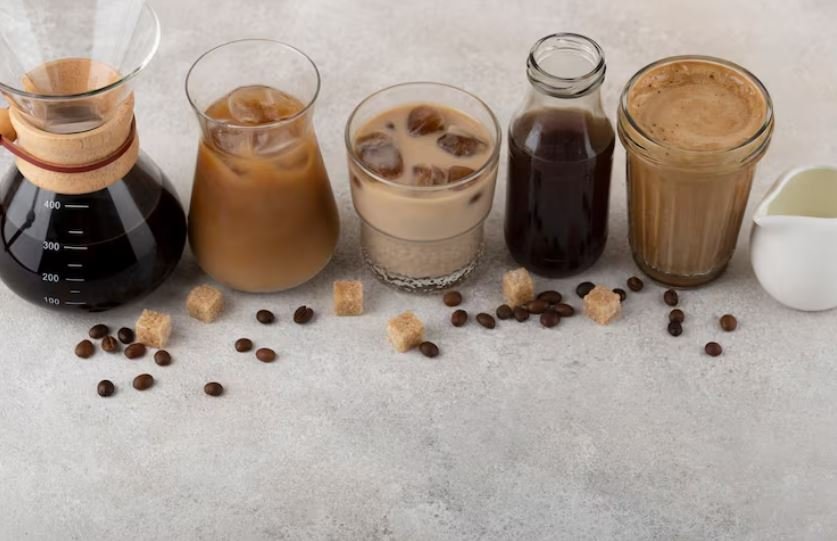
However, the true change occurs when you enter the realm of sweet cream. At a large coffee chain, a sixteen-ounce cold brew of vanilla sweet cream contains about 250 calories, 27–30 grams of sugar, and 14 grams of fat. That’s about the same as a pepperoni pizza slice. The add-ons—mostly sugar and saturated fat—do all the nutritional heavy lifting; the base drink is virtually calorie-free.
Here, it’s important to be truthful. Most coffee shop menus now have a cold brew section that is very different from the original idea. What began as a less acidic, smoother substitute for iced coffee has subtly developed into a whole category of beverages that, in terms of nutrition, resemble milkshakes more than cups of coffee. People are free to enjoy what they want, so that’s not necessarily a problem. However, it’s simple to order something that says “cold brew” and think you’re being health-conscious when, in fact, you’ve ordered a drink that has more sugar than a can of soda.
This is an honest comparison between iced and cold brew coffee. Iced coffee has a slightly different flavor profile and more acidity because it is hot-brewed and then chilled. Due to the low extraction temperature, cold brew is smoother, naturally slightly sweeter, and significantly less acidic—by some measures, about 67% less acidic. Drunk black, the difference in calories between the two is almost negligible. Each has fewer than ten calories per sixteen ounces. Both the milder stomach experience and the caffeine edge go to cold brew.
Plain black cold brew is one of the more dependable options for those who are intermittently fasting or calorie-conscious. Nothing significant will be derailed by it. Although the flavor and caffeine are present, the calorie impact is minimal. As usual, the modifiers are where the complexity lies. Before assuming that cold brew equals clean drinking, consider what’s really in the cup. The coffee is good on its own. The math is altered by everything that sits on top of it.
